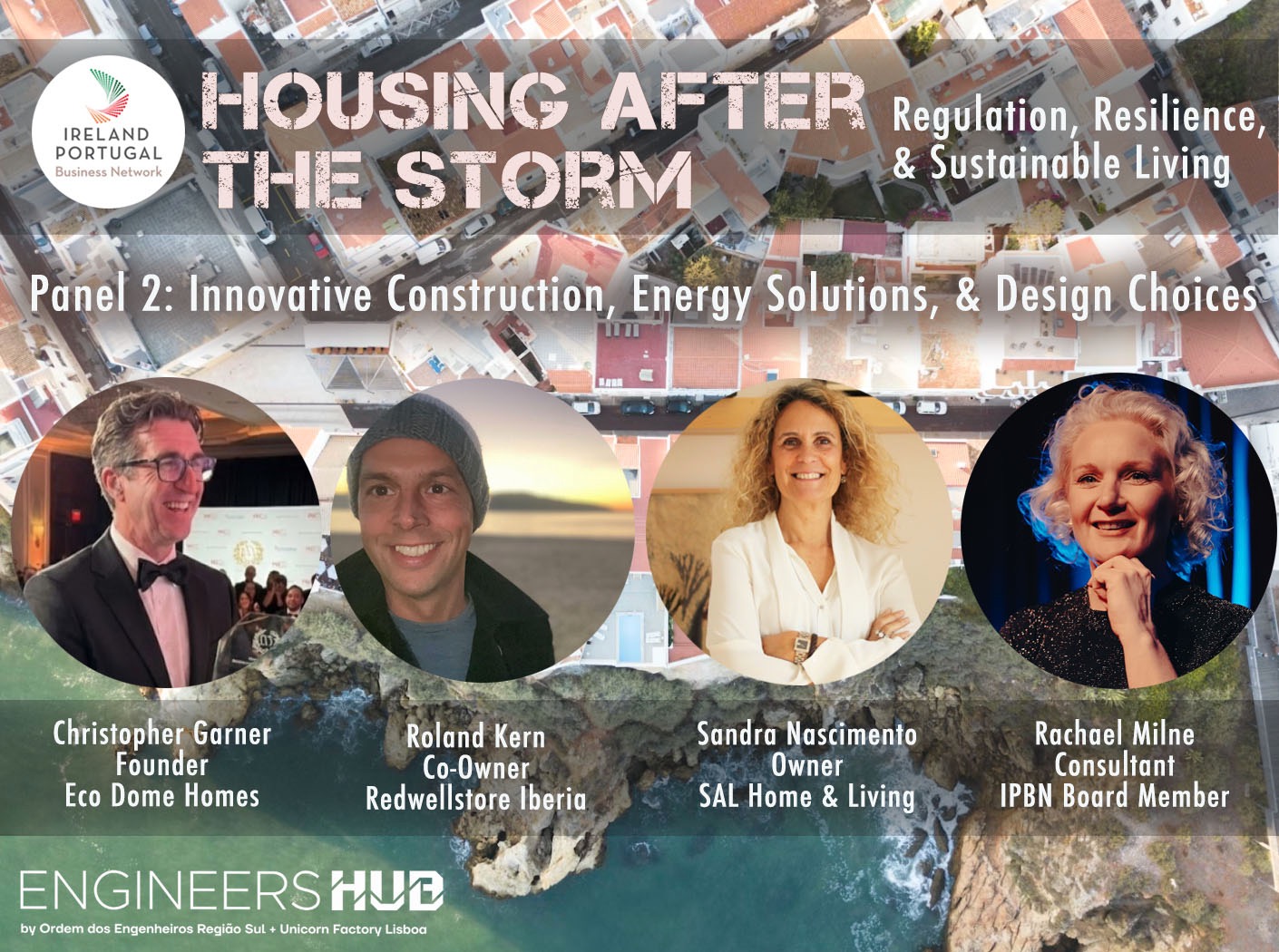
In the wake of recent severe weather events across Europe, the conversation around the future of housing has shifted dramatically. It's no longer just about building efficiently; it's about building for absolute survival.
Recently, the Ireland Portugal Business Network (IPBN) hosted a timely and crucial event in Lisbon entitled "Housing After the Storm: Regulation, Resilience & Sustainable Living." Bringing together leaders from across the construction, design, and energy sectors, the event explored how we must adapt the housing industry to meet growing climate volatility.
We are proud to share that Memorable Green and EcoDomeHomes.com were right at the center of this vital conversation. Our founder, Christopher Garner, took the stage for Panel 2: Sustainable, Cost-Effective & Human-Centred Living, to challenge conventional building legacy norms and showcase how advanced engineering can redefine structural resilience.
Moving Beyond Legacy Construction
For generations, traditional "legacy" construction has relied on methodologies that treat housing as a short-term asset. But as extreme weather patterns intensify, these traditional builds are increasingly exposed as vulnerable.
During the panel, we highlighted a different philosophy: viewing housing not just as a consumer product, but as long-term infrastructure for living.
To truly rebuild after the storm, we cannot simply replicate the same fragile patterns of the past. We need structures engineered from the ground up to be completely disaster-proof, climate-resilient, and exceptionally energy-efficient. That is exactly what we are deploying through our sustainable community developments.
The Engineering Advantage: Simplicity and Extreme Durability
Airformed, super-insulated concrete dome structures provide a definitive answer to the complex challenges brought by climate shift. By replacing traditional multi-layered, vulnerable framing with a seamless, monolithic concrete shell, our builds deliver unparalleled structural integrity.
- Disaster-Proof Design The aerodynamic physics of a continuous dome hull coupled with reinforced concrete makes these structures inherently resistant to extreme winds, high impacts, and seismic activity.
- Super-Insulated Efficiency By integrating advanced insulation with the high thermal mass of a continuous concrete shield, these homes maintain stable internal temperatures with a fraction of the energy consumption required by standard builds.
- High-Performance, Fair Pricing We believe that building responsibly shouldn't mean pricing people out. Our high-margin business model allows us to deliver these advanced, carbon-negative, monolithic structures at cost-parity with traditional legacy market rates.
Collaboration for a Smarter Future
Rebuilding after a disaster requires a multi-faceted approach. We were honored to share the stage with fellow innovators like Roland Kern from Redwell Iberia, who brought insights into advanced, cost-effective infrared heating systems, and Sandra Nascimento from SAL Home & Living, who emphasized human-centered, adaptable interior design.
The IPBN event proved that cross-border collaboration between Ireland and Portugal is a powerful catalyst for change. The housing market is facing unprecedented pressure, but by combining advanced energy systems, thoughtful design, and our ultra-resilient monolithic concrete technology, we can build communities that don't just weather the next storm — they stand completely impervious to it.
As we continue to expand our operations and push the boundaries of what sustainable development looks like, we want to thank the IPBN for providing a platform for these essential discussions.
The future of housing is resilient, carbon-negative, and permanent.